


|
What this covers
|
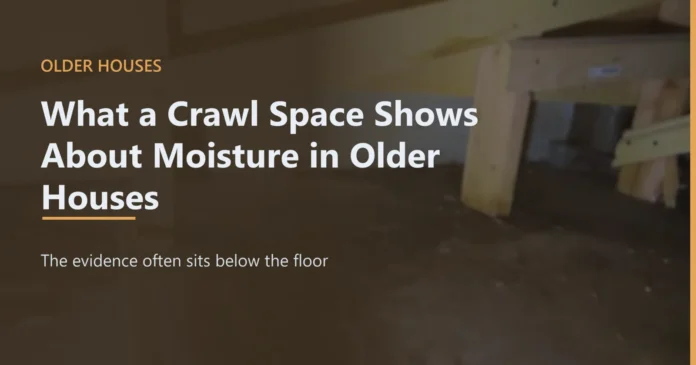
In a house on a raised foundation, the room you live in can look perfect while the problem sits two feet below your floor.
That is the defining trait of crawl space moisture. It is out of sight, out of mind, and usually found by accident: a musty smell in a closet, a floor that feels soft near an outside wall, a pest technician who mentions what he saw. By then the moisture has often been there a long time.
This article covers what a crawl space can reveal, how it is checked, and why older neighborhoods with raised foundations carry more of this than most owners expect.
Why Raised Foundations Behave Differently
A house on a concrete slab sits directly on the ground. A house on a raised foundation sits on short walls or piers, with a gap below the floor framing. That gap is the crawl space.
The gap has advantages. It gives access to plumbing and wiring, and it lets the floor structure breathe. It also exposes wood framing, a subfloor and sometimes ductwork to whatever moisture the ground and the air supply. Soil releases water vapor. Vents bring in outside air. Pipes and drains run through it.
Each of those inputs changes with the season. Ground moisture rises after the winter rains. Vent air carries more humidity on foggy mornings near the coast. A pipe that weeps only under pressure may leak only when the whole house is in use. A crawl space is not one condition. It is a set of conditions that shift, and a single dry reading on a single day does not describe it.
Wood is the key material. Common building guidance treats wood moisture readings above about 20 percent as the range where decay and mold risk start to rise. A crawl space can hold framing in that range for long stretches without anything visible upstairs.
Old Torrance Is Built Around This
Torrance was founded in October 1912 as a planned community. The Olmsted firm laid out the original tract of 109 city blocks, and the early civic and residential buildings include work by the architect Irving Gill. Gramercy and Andreo were the first two residential avenues, in the area now called Old Torrance, and many houses on those avenues passed their 100th year in 2012.
Houses of that age are commonly built on raised foundations, which means crawl spaces. They also carry a century of layered work: replaced plumbing, added rooms, new flooring over old, repairs made by people who never opened the space below. Each change is a chance for water to enter and a place for it to hide.
What a Crawl Space Inspection Looks For
The first step is a conversation, because history points at the problem faster than any instrument. Has the house had a leak? Is there a smell that comes and goes? Has any work been done underneath?
Then the physical checks begin:
- Visual evidence. Staining on framing, damp or compacted soil, standing water, and signs of past leaks around pipes
- Moisture readings. A meter reads the framing and subfloor and gives numbers that can be compared from one spot to the next
- Thermal imaging. It shows temperature differences that can reveal wet material in places that look dry
- A borescope. It lets the inspector see into a tight cavity without opening it up
The aim is to find the water source, not just the mold. Cleaning visible growth without stopping the water that feeds it is the pattern that brings the problem back.
|
What is seen under the floor |
Likely moisture source |
How it is confirmed |
|
Wet soil near a pipe |
A slow supply or drain leak |
Moisture readings tracing to the pipe |
|
Damp framing along an outside wall |
Ground or surface water entering |
Readings that are higher near the wall |
|
Staining under a bathroom or kitchen |
Plumbing above or a failed seal |
Readings and thermal imaging beneath that room |
|
Moisture on ductwork or the underside of the subfloor |
Condensation |
Temperature differences and readings on the surface |
|
Even dampness across the whole space |
Poor ventilation or ground vapor |
Broad, consistent readings with no single peak |
Why the Living Space Can Look Fine
Rooms above a damp crawl space can feel normal for a long time. Floors are covered. Walls are painted. The moisture is below, and the only signals are indirect: an odor that shows up after rain, a floor that feels cool or slightly soft, humidity that never quite drops in a closet.
Some of the air in a house comes from below it. Air moves up through gaps around pipes, wiring and floor edges, so conditions in a crawl space can reach the rooms above. That is the reason a crawl space matters even for someone who never goes into it.
It also explains an odd symptom. A smell that appears after rain, or in the morning, and fades by afternoon is often a sign of air moving up from a damp space below. The smell comes and goes because the conditions below do, and an owner who waits for it to become constant may wait a long time. Noting the day and the weather each time it appears gives the inspector a pattern to work from, and a pattern is worth more than a single recollection.
What a Slow Problem Looks Like Over Time
Crawl space moisture tends to follow a pattern. In the first season, the framing takes on water and nothing shows above. In the second, surface growth may appear on the wood, and the subfloor begins to hold moisture through the dry months. After several seasons, wood that stays wet can begin to soften, and the signs move upward: a spongy section of floor, gaps at baseboards, doors that stick.
That sequence is not a schedule. It depends on the source, the climate and the ventilation. It does describe why early findings are cheaper to deal with than late ones, and why a quick look below the floor is useful even when the rooms above seem fine.
When Testing Adds Something
A crawl space inspection does not automatically include sampling. If the water source is plain and the growth is visible, the next step is repairing the water problem, and a sample would not change it.
Testing earns its place when growth is hidden, when someone in the house has symptoms and wants to know what is in the air, or when a result has to stand up to a buyer, a seller or an insurer. Air and surface samples go to an independent accredited laboratory. Indoor results are compared with an outdoor control taken on the same day, because indoor air is a relative measure.
Torrance Is Not One Climate
Torrance runs from the coast well inland. Near Torrance Beach and through the western neighborhoods, marine humidity keeps interior surfaces damp longer and salt air works on exterior finishes. Further inland and toward Del Amo the humidity drops, and moisture problems are more often mechanical or plumbing related.
|
Part of the city |
Housing pattern |
Typical moisture pattern |
|
Old Torrance |
Early 20th century houses on raised foundations |
Crawl space moisture, layered repairs |
|
Southwood, Seaside Ranchos, Walteria, West and North Torrance |
Postwar tract houses on slabs, mostly 1950s and 1960s |
Slab leaks and aging supply lines |
|
Coastal and western neighborhoods |
Mixed housing near the water |
Higher background humidity |
|
East toward Del Amo |
Mixed housing and commercial buildings |
Plumbing and mechanical sources |
For a crawl space that matters. A house near the coast starts with higher background humidity under the floor, and an inland house tends to need a specific source, such as a leak, to produce the same condition.
Using the Findings
A written report is useful beyond the inspection. It can be taken to a remediation contractor for comparable quotes, to an insurer in support of a claim, or to a seller or tenant when the cause of a problem is disputed. The report is more useful when the inspector does not also sell the repair, because the recommendation is shaped by the building rather than a follow-up job.
Questions Worth Asking Before You Book
- Will the inspector enter the crawl space, or only look at the living areas?
- Which readings will be taken, and where?
- Will the findings include photographs and a written recommendation?
- Is the inspection independent of any company that does the repair?
- How soon will the written report arrive?
Where to Check Locally
For the South Bay, Golden State Mold Inspections provides mold inspection and testing throughout Torrance, with same-day availability when a situation cannot wait, and you can check the Torrance service details on its page. The company also explains how air and surface testing works in its Los Angeles testing guide, and it is listed on a Google Business Profile.
The takeaway is straightforward. In an older raised-foundation house, the evidence often sits below the floor, and the way to read it is to go and look.

