


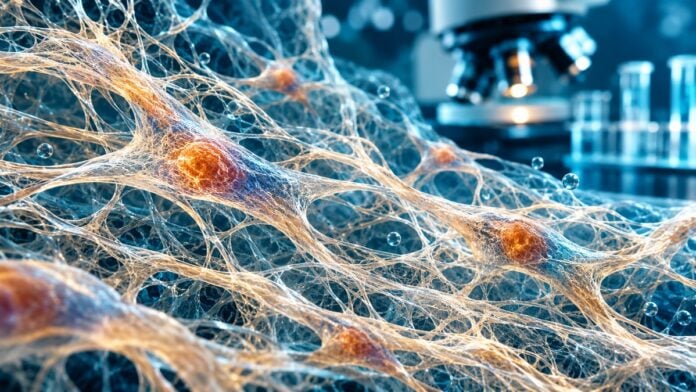
Collagen is often discussed in relation to skin, connective tissue, and structural support. In biomedical research, however, its significance extends considerably further. Collagen forms part of the extracellular environment that surrounds cells, influencing the physical and biochemical conditions under which many cellular processes occur.
Researchers studying tissue biology increasingly recognize that cells cannot be understood entirely in isolation. Their surroundings contribute information that influences attachment, movement, organization, and communication. The extracellular matrix, commonly abbreviated as ECM, provides much of this surrounding environment.
Investigating collagen and its relationships with other extracellular components helps scientists understand how tissues develop, maintain their organization, and respond to changing conditions. It also provides a scientific framework for examining peptides associated with extracellular matrix research.
Understanding the Architecture Surrounding Cells
Cells within a tissue occupy an organized environment containing proteins, carbohydrates, water, and other molecular components. Together, these materials contribute to the extracellular matrix. Its composition varies between tissue types, reflecting differences in their structural and biological requirements.
Collagen contributes substantial structural organization to many of these environments. Other extracellular components, including elastin, fibronectin, laminins, and proteoglycans, contribute distinct properties and molecular interactions.
Rather than functioning as an inactive supporting framework, the extracellular matrix participates in communication between cells and their surroundings. Its composition can influence how cells interpret biochemical signals and how they respond to mechanical conditions.
Richard Hynes examined these relationships in a 2009 review published in Science. The paper described how extracellular matrix proteins participate in cellular signaling through interactions with adhesion receptors and other biological molecules.
This broader interpretation of extracellular biology has important implications for laboratory research. A cellular response observed in one experimental environment may differ from a response observed in another, even when researchers investigate the same biological question.
What Makes Collagen Structurally Distinctive?
Collagen possesses a characteristic molecular architecture that distinguishes it from many other proteins. Its structure involves three associated polypeptide chains arranged into a triple helix. The organization of these chains contributes to the physical properties of collagen-containing materials.
Matthew Shoulders and Ronald Raines discussed collagen structure and stability in a 2009 review published in the Annual Review of Biochemistry. Their work examined the molecular factors contributing to triple-helix formation and stability.
Different collagen types exhibit different structural arrangements and distributions throughout biological tissues. Some contribute to organized fibrillar structures, while others participate in specialized extracellular networks.
These distinctions matter when interpreting biomedical experiments. A study examining one collagen type does not necessarily provide equivalent information about every other collagen family member.
Understanding these differences also prevents misleading comparisons between laboratory investigations. Researchers need to consider the specific collagen molecule, experimental material, and biological environment described in a publication before drawing broader conclusions.
Fibroblasts and the Maintenance of Extracellular Materials
Fibroblasts are frequently examined in studies of connective tissue biology because of their involvement in producing and organizing extracellular components. Their activities contribute to the development and maintenance of the environments surrounding cells.
Laboratory investigations involving fibroblasts can examine several different aspects of cellular behavior. Researchers may investigate changes in gene expression, protein production, cellular movement, or interactions with surrounding materials.
These measurements represent separate biological questions. Increased expression of a gene associated with collagen production, for example, does not necessarily establish that additional functional collagen structures have formed.
Similarly, measuring the presence of a particular protein does not independently establish how effectively that protein has been incorporated into an organized extracellular network.
Readers interested in the terminology used throughout peptide and cellular biology literature can consult this educational resource alongside peer-reviewed publications and established scientific references. Understanding the vocabulary of experimental biology makes it easier to distinguish reported observations from wider interpretations.
How Cells Interpret Their Mechanical Environment
The physical characteristics of the extracellular matrix contribute another dimension to tissue research. Cells interact with materials that possess different degrees of stiffness, flexibility, and structural organization.
These physical differences can influence cellular behavior through processes collectively associated with mechanotransduction. In this area of research, scientists investigate how physical information is translated into intracellular biochemical responses.
Cellular attachment structures provide important connections between extracellular materials and internal cellular architecture. Through these connections, researchers can examine how changes in the surrounding environment relate to cellular organization and signaling.
Consider two hypothetical laboratory studies investigating the same cell type. One uses a relatively rigid experimental surface, while the other uses a softer material designed to represent selected properties of biological tissue.
Differences between their observations might arise partly from the physical characteristics of their respective experimental environments. Without considering those conditions, readers could incorrectly assume that the studies produced contradictory biological findings.
This example illustrates why laboratory materials and experimental context deserve attention when evaluating published research.
Peptides Within the Study of Tissue Remodeling
Peptides represent one of several molecular categories examined in research involving extracellular environments. Scientists may investigate them as potential participants in molecular recognition, cellular communication, or biochemical processes associated with tissue organization.
The scientific questions associated with individual peptides vary considerably. Some investigations focus on interactions between specific molecules. Others examine cellular markers or changes within experimental biological systems.
Educational classifications covering tissue remodeling and peptide research can help readers identify related areas of investigation. However, membership in a shared research category does not establish that the included compounds possess equivalent properties or supporting evidence.
Each compound must be evaluated independently according to its molecular identity, the quality of available studies, and the relevance of the experimental findings.
A laboratory observation involving a cellular marker should remain distinct from evidence concerning the organization of complete tissue. Likewise, observations in experimental animals cannot independently establish corresponding outcomes in humans.
Maintaining these distinctions allows researchers to communicate findings accurately without extending conclusions beyond the available evidence.
GHK-Cu as an Example of Copper-Peptide Research
One historical example connecting peptide chemistry with extracellular matrix investigations involves glycyl-L-histidyl-L-lysine, commonly abbreviated as GHK, and its association with copper.
In October 1988, Francois-Xavier Maquart and colleagues published an investigation in FEBS Letters examining a copper-associated GHK complex in fibroblast cultures. The researchers reported changes in collagen synthesis within their experimental cell system.
The study provides an example of how researchers can investigate relationships between defined molecular entities and selected cellular processes. Its findings must be interpreted within the context of the cultured fibroblast model used in the investigation.
Readers reviewing Peptides Providence’s GHK-Cu overview may encounter references to related areas of scientific interest. The original research literature remains necessary for understanding the experimental methods, measured outcomes, and limitations associated with those observations.
Historical cell culture research does not independently establish clinical effectiveness, safety, or suitability for human use. It also does not demonstrate that different materials described using the same compound name possess equivalent analytical characteristics.
Why Measuring Collagen Requires More Than One Observation
Collagen-related research presents several distinct measurement challenges. Investigators may be interested in how much collagen a biological system produces, how it is organized, or how its structural characteristics change over time.
These questions cannot always be answered through a single analytical measurement. Different methods provide information about different aspects of the biological system.
Gene expression analysis can help researchers examine molecular activity associated with particular genes. Protein-based measurements can provide information about the presence or relative abundance of selected molecules.
Microscopy can contribute spatial information, allowing researchers to investigate the distribution and organization of extracellular structures. Mechanical characterization may provide complementary information about the physical behavior of experimental materials.
Combining appropriate measurements can help distinguish between competing interpretations. For instance, a change in protein abundance might be accompanied by changes in extracellular organization, or those two observations might occur independently.
The selection of analytical methods should therefore reflect the specific question being investigated rather than an assumption that every measurement provides interchangeable evidence.
The Differences Between Two-Dimensional and Three-Dimensional Models
Traditional cell culture systems often involve cells growing on relatively flat laboratory surfaces. These systems remain useful for investigating numerous biological questions, particularly when researchers need to examine clearly defined cellular responses.
Three-dimensional research models introduce additional structural relationships by allowing cells to interact with surrounding materials in more spatially complex environments.
Such models can help researchers investigate selected characteristics of tissue architecture that are difficult to represent on flat surfaces. However, greater structural complexity does not automatically make a model appropriate for every research question.
Each approach has limitations. Simpler systems may support clearer interpretation of individual variables, while more complex systems may introduce additional interactions that require careful characterization.
When comparing studies involving different models, readers should consider what each model was designed to represent. An experimental system may reproduce particular characteristics of tissue biology without reproducing the complete behavior of a living organism.
Separating Molecular Evidence From Wider Biological Claims
One of the most important skills in reading biomedical literature is recognizing the boundaries of individual findings. A study may provide convincing evidence for a narrowly defined molecular interaction while offering little information about broader biological outcomes.
For example, an observed change in extracellular protein production may be scientifically meaningful within a controlled laboratory investigation. Establishing how that observation relates to complete tissue function would require additional evidence addressing different biological questions.
Independent replication also matters. Findings become easier to interpret when multiple investigations examine related questions using appropriately characterized materials and transparent experimental methods.
Scientific reviews can help readers understand relationships between publications, but they should not replace examination of original research when a specific experimental claim requires verification.
Readers should pay particular attention to the distinction between observations, proposed explanations, and conclusions. These elements contribute differently to scientific understanding and should not be presented as though they carry identical evidentiary weight.
Why Extracellular Matrix Biology Remains a Significant Research Field
The extracellular environment connects molecular chemistry with the physical organization of biological tissues. Its study requires researchers to consider relationships among proteins, cells, signaling systems, and mechanical conditions.
Collagen provides a particularly informative example because its molecular architecture contributes to larger extracellular structures. Investigating how those structures interact with cellular processes can help explain observations that would otherwise be difficult to interpret through isolated molecular measurements.
Peptide-related investigations contribute additional questions concerning molecular recognition and biochemical communication. Their significance depends on the strength of the supporting evidence and the characteristics of the experimental systems involved.
As analytical technologies and biological models continue to develop, researchers have additional opportunities to examine these relationships in greater detail. Accurate characterization, transparent reporting, and careful interpretation remain essential throughout that process.
The most useful understanding of collagen and extracellular matrix research comes from connecting individual molecular observations with their experimental context, while recognizing which broader biological questions remain unanswered.

