


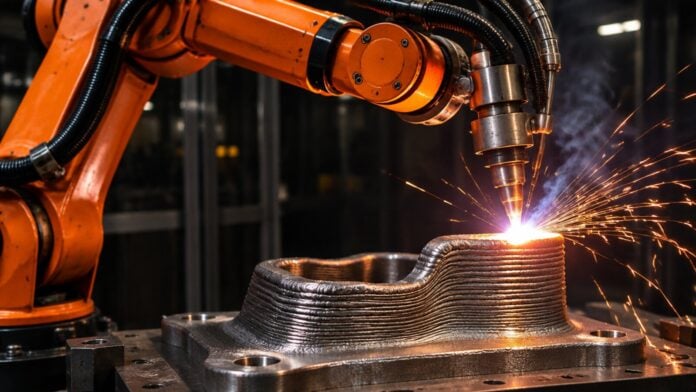
Most people picture 3D printing as a small plastic printer on a desk. Industrial metal printing at scale looks very different. A robot arm carries a deposition head that melts metal and lays it down in beads, one layer on top of the last, building up a part much as a bricklayer builds a wall.
This kind of process can make large parts without molds, dies or casting patterns, which is why it appeals to industries that need big, low-volume metal components. It is also the starting point for Solideon, a Los Angeles company that turns standard industrial robots into deployable factories.
Why printing alone is not enough
A freshly printed metal part is not finished. The surface is ridged where the layers meet, the dimensions are deliberately oversized, and internal quality has to be checked. In a conventional shop, that means moving the part to a CNC machine, then to assembly, then to an inspection station.
Solideon’s system does those steps in one place. Several robot arms work on the same part: one deposits metal, another machines it to final shape, others position and assemble components, and the system checks the result. The company’s software, including an AI orchestration layer called Alopium, plans the sequence and keeps the machines coordinated.
Designing for the process
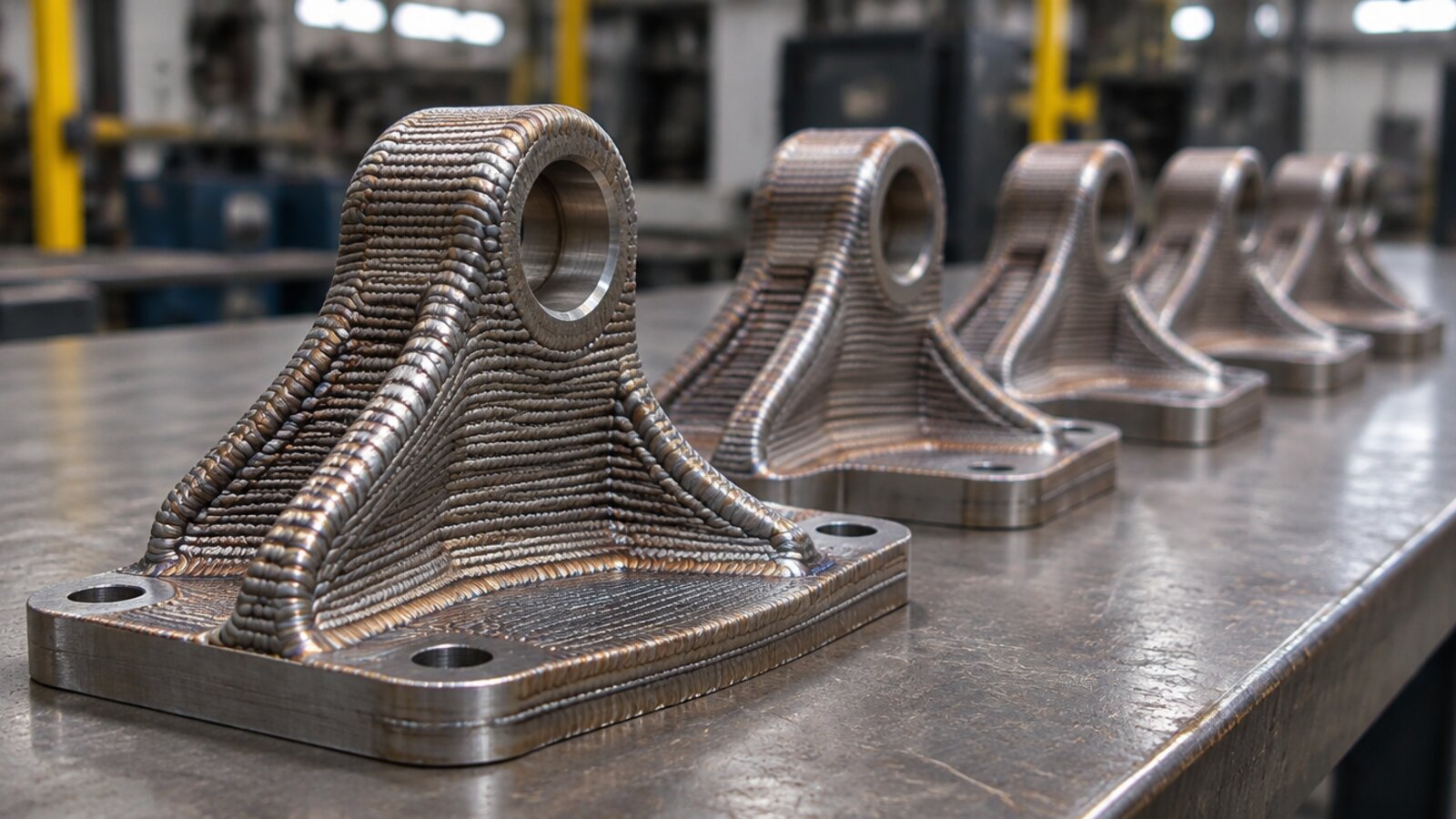
Because the part is built up rather than cut down, the design can put material only where it is needed. Solideon says designs optimized this way can be up to 20% lighter. The company uses generative, AI-optimized design and materials that can be reliably sourced, and says the process requires no traditional tooling, a step it puts at four months or more in conventional manufacturing.
Founder and CEO Oluseun Taiwo learned the technique in rocket propulsion, where metal printing let engineers make engine parts that were difficult or impossible to machine. He has described how the robots that printed those parts started to change the whole manufacturing process.
From the lab to the field
Today Solideon’s deployable cells produce parts around the size of a bicycle component or a small car part. The U.S. Air Force has funded a single-pallet cell for expeditionary sites, and the company’s Norfolk, Virginia, operation makes submarine hull sections and other large defense hardware from raw stock.
The physics of laying down metal a bead at a time has not changed much. What has changed is the software that lets one cell do the work of a production line.

