


Published in Sensors (MDPI), https://doi.org/10.3390/s23031437
Researchers at The Ohio State University have developed a low-cost, active hyperspectral imaging system that can perform precise spectral analysis even in dark or low-light environments — a capability previously unattainable by conventional hyperspectral cameras.
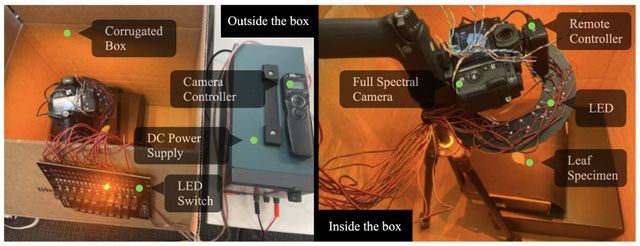
Traditional hyperspectral imaging relies on passive light collection, depending on sunlight or ambient illumination to analyze an object’s spectral characteristics. This new system, led by Yang Tang, Shuang Song, Shengxi Gui, Weilun Chao, Chinmin Cheng, and Prof. Rongjun Qin, introduces an active design that uses synchronized LED light sources emitting single-wavelength illumination at 19 distinct frequencies. The prototype integrates this programmable LED array with a full-spectrum camera, allowing it to capture highly detailed hyperspectral data across both visible and infrared ranges.
“Our prototype demonstrates that accurate spectral imaging can be achieved in complete darkness, using only low-cost, off-the-shelf components,” said lead author Yang Tang. “It opens new possibilities for applications in geochemistry, underground exploration, and precision agriculture.”
🔬 Key Innovations
Active Illumination: Unlike passive systems, this camera actively emits controlled monochromatic light to standardize illumination and extract consistent reflectance information.
Broad Spectral Range: The 19 narrowband LEDs cover 365–1050 nm, capturing ultraviolet, visible, and infrared information.
Compact and Affordable Design: The prototype uses commercially available components, making it accessible for laboratory and field applications.
🧪 Experimental Validation
Three sets of experiments confirmed the system’s effectiveness:
Food Freshness Detection: The system identified changes in strawberry ripeness over 48 hours, which were invisible to RGB cameras.
Real vs. Printed Leaves: Hyperspectral data easily distinguished real leaves from their printed counterparts based on spectral reflectance differences.
Rock Classification: Using simple machine learning models, the system achieved a 90% accuracy rate, outperforming RGB-based models by 22%.
🚀 Potential Impact
This breakthrough paves the way for low-cost hyperspectral sensors suitable for use in mining, planetary exploration, environmental monitoring, and subsurface imaging, where light is scarce or nonexistent. Future developments aim to miniaturize the system further and automate synchronization for faster, real-time imaging.
Citation:
Tang, Y.; Song, S.; Gui, S.; Chao, W.; Cheng, C.; & Qin, R. (2023). Active and Low-Cost Hyperspectral Imaging for the Spectral Analysis of a Low-Light Environment. Sensors, 23(3), 1437.

