


Written by: Riley Sloane
The National Museum of China, the country’s premier cultural institution, has opened its halls to the cosmos. Inside this colossal museum, visitors are now invited to journey through time and space in an extraordinary art-science exhibition. Titled Cosmos Archaeology – Explorations in Time and Space, the ongoing exhibition transforms the nation’s leading museum into a gateway to the stars, integrating China’s illustrious history with the boundless poetry of the universe.
Stepping into Cosmos Archaeology – Explorations in Time and Space feels like crossing the threshold into a cosmic temple. The exhibition – jointly organized by the Embassy of Switzerland in China, the National Museum of China (NMC), and Switzerland’s EPFL (École Polytechnique Fédérale de Lausanne), with support from Tsinghua University’s departments of astronomy and art – was officially unveiled in Beijing on July 2, 2025. It marks the first Swiss-led exhibition at the new NMC and a highlight of the 75th anniversary of Swiss-Chinese diplomatic relations, symbolizing deepening cultural and scientific cooperation between the two nations. As visitors wander through the museum’s vast galleries, they start on an immersive voyage that bridges innovation and imagination, science and art, all under the roof of China’s most venerated museum.
Within the exhibition, real celestial data and cutting-edge visuals intertwine to tell humanity’s cosmic story. Curators from EPFL’s Experimental Museology lab and Tsinghua University have crafted a journey through four thematic sections – from “Instruments and Technologies – Mapping the Cosmos” to “The Starry Sky of Big Data”, “Sustainable Space”, and “The Future – Interstellar Journeys”. Historical star maps and antique telescopes stand alongside interactive digital displays and kinetic sculptures that make the invisible visible. In one moment, a visitor is tracing ancient constellations on a Song Dynasty star chart; the next, they are swiping through billions of light-years of galaxy data or confronting a swirling installation about space debris. Cosmos Archaeology masterfully integrates scientific exploration with artistic interpretation, presenting authentic cosmic datasets – star coordinates, planetary orbits, signals from afar – in imaginative mediums that engage the senses. The result is a multi-sensory narrative of humanity’s quest to understand the universe, viewed from both global and Chinese perspectives. It is as if the National Museum has opened a window to the heavens, encouraging every visitor to look up in wonder.
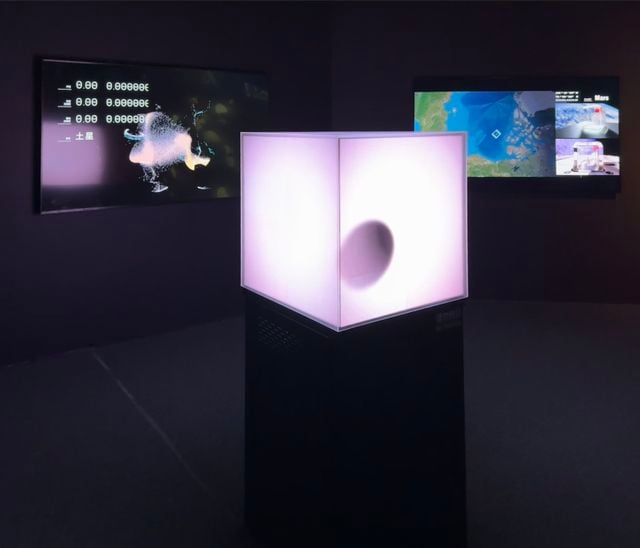
Among the exhibition’s international array of artworks, one installation invites visitors not just to look, but to listen. Well-known product designer Yiyun Qiu’s Cosmusica, a highlight of the show, is described as an interactive “art satellite” that transforms real-time space data into music. In this poetic creation, electromagnetic waves captured from distant celestial bodies – normally silent to our ears – are translated into an ever-evolving symphony of sound. Gentle harmonies rise and fall in real time, driven by the whisper of solar winds or the subtle pulse of starlight. Standing before Cosmusica, one can hear the cosmos as a vast musical instrument – a celestial music box playing the secret soundtrack of the night sky.
Cosmusica is truly astonishing in that it is not only inspired by space, but born in space. In December 2023, Ms. Qiu’s artistic satellite was even launched into orbit, soaring 500 km above Earth in a sun-synchronous trajectory to collect its cosmic melodies first-hand. Now back on Earth within the museum, it invites the public to share in that experience: to press an ear to the universe and sense our planet’s small but meaningful part in a grand cosmic chorus. Qiu, an award-winning Chinese artist and designer, drew on both her scientific curiosity and her cultural imagination to create Cosmusica. By uniting aerospace technology with art, she offers a piece that is at once a scientific instrument and a dreamscape of sound. Visitors often pause in reverent silence, eyes closed, as the ambient tones from distant galaxies wash over them. In these moments, the bustling museum gallery fades into a starry expanse of sonic wonder.
Reflecting on what she hopes people take away from the exhibition, Ms. Qiu shares a thought filled with humility and awe. “The cosmos has a silent music of its own, and I dream that we might tune our hearts to it,” she says softly, standing beside her work’s gentle glow. “Through this exhibition, I hope each person can pause to listen and feel a profound connection – as if, in the vast darkness of space, we find a shared light of wonder here on Earth.” Her words capture the spirit that Cosmos Archaeology instills: a sense that art can be our antenna, extending our senses into the universe and returning with messages of inspiration.
In the National Museum of China’s great hall, beneath banners of both China and Switzerland, Cosmos Archaeology – Explorations in Time and Space is currently welcoming visitors of all ages to engage with the stars. This groundbreaking exhibition is on view until October 12, 2025, in Gallery N8 of the National Museum in Beijing. As China’s foremost museum stands as the host for this celestial journey, it reinforces its role as a guardian of national history. In inviting the public to listen to the universe through creations like Cosmusica, the National Museum of China affirms that our heritage is not just behind us in artifacts and relics – it is above us as well, written in the stars. And now, through the universal language of art and music, the cosmos is finally within earshot, calling on each of us to wonder, to dream, and to explore.

