


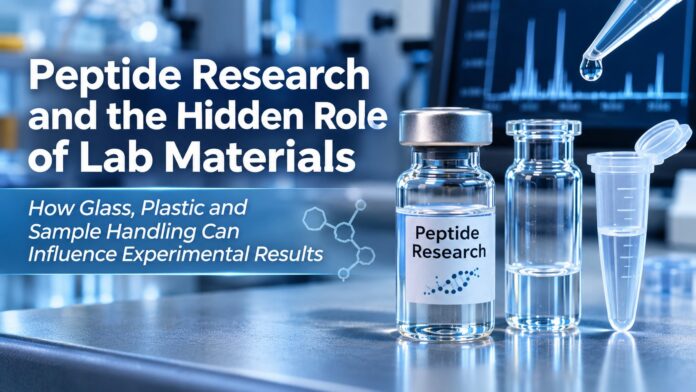
A peptide can enter a laboratory with the correct chemical identity and still produce a misleading experimental result. The problem may not originate with the molecule itself. It may begin when the sample encounters a glass vial, a plastic tube, a transfer surface, or another material that researchers rarely mention in their final paper.
Laboratory equipment is often treated as a neutral container for scientific work. In reality, materials that contact a sample can influence how much of a compound remains available for measurement. Some molecules attach to surfaces. Others interact with components of their surrounding solution. Changes in recovery can influence the signal detected by analytical instruments or biological assays.
For peptide research, that creates a difficult distinction. A sample may have been identified correctly before an experiment, yet the amount of peptide reaching the final measurement may differ from what investigators expect. Understanding this difference requires scientists to examine the materials and conditions surrounding the experiment, not simply the original certificate of analysis.
Why the Container Can Become Part of the Experiment
Scientific experiments often depend on a simple assumption: the measured sample represents the material that was prepared. That assumption becomes less reliable when some of the material adheres to the surrounding container instead of remaining in the solution being examined.
Surface adsorption occurs when molecules accumulate at an interface, such as the boundary between a liquid and a glass or plastic surface. For certain peptides, these interactions can reduce the amount remaining in solution. The material has not necessarily disappeared or undergone chemical decomposition. Some of it may simply be attached to the container.
A 2015 study published in PLOS ONE, titled “Adsorption of Cationic Peptides to Solid Surfaces of Glass and Plastic,” investigated three cationic membrane-active peptides: mastoparan X, melittin, and magainin 2. Researchers used analytical high-performance liquid chromatography to examine peptide recovery from different sample containers.
The researchers reported that 90 percent or more of the tested peptides could be lost from solution through rapid adsorption under certain experimental conditions. That is a substantial result, but it must be interpreted carefully. The study investigated specific peptides, concentrations, and laboratory materials. Its findings do not establish that every peptide experiences the same loss.
The broader scientific lesson is that container selection can become an experimental variable. When researchers fail to record that variable, an unexplained difference between laboratory results may be attributed to the wrong cause.
Glass and Plastic Do Not Behave the Same Way for Every Peptide
Glass is often associated with chemical cleanliness and laboratory reliability. Plastic containers are widely used because they are convenient, inexpensive, and available in many formats. Neither material is universally suitable for every peptide.
A 2011 study in Analytical Biochemistry examined how different glass and plastic surfaces affected the recovery of several labeled endocrine peptides. Researchers observed substantial differences among container materials, and the direction of those differences varied by peptide.
For example, some peptides showed improved recovery in polypropylene compared with other tested surfaces. Insulin, however, demonstrated a different pattern, with comparatively poor recovery from polypropylene in that experiment.
This matters because the phrase “laboratory-grade container” does not describe a single chemical behavior. A material that performs well with one substance may produce unwanted losses with another.
Surface chemistry, molecular charge, hydrophobic interactions, and the composition of the surrounding solution can all influence adsorption. Consequently, researchers should avoid assuming that one preferred container material will perform equally well across unrelated compounds.
The appropriate scientific question is not which material has the strongest general reputation. It is whether the material has demonstrated acceptable performance for the specific analytical purpose under investigation.
What Happens When the Sample Passes Through Several Containers?
A single experiment may involve more than one sample container. A material can move through different stages of preparation, storage, measurement, and transfer. Each stage creates another opportunity for the sample to encounter a surface.
In the 2015 PLOS ONE investigation, researchers also studied repeated transfers between containers. They found that successive contact with ordinary glass or polypropylene surfaces could further reduce the amount of certain peptides recovered from solution.
That finding provides an important explanation for some apparent laboratory disagreements. Two investigators may begin with chemically comparable materials but use different workflows. One may expose the sample to more surfaces, while the other may use different container materials. Their resulting measurements can differ even though the initial molecular identity was correct.
Such a difference does not automatically mean that a reported biological effect is false. It does mean the actual exposure or analytical concentration may be uncertain unless the workflow has been evaluated.
The distinction is especially relevant when laboratories compare results across experiments conducted months apart or across different institutions. A protocol described merely as “standard laboratory preparation” may conceal differences substantial enough to influence the outcome.
Why a Correct Purity Report Cannot Eliminate Surface Loss
A purity measurement and a sample-recovery measurement answer different questions. Purity testing describes particular chemical characteristics of the material examined under the analytical method used. Recovery testing addresses how much of an analyte can be retrieved and measured through a defined process.
A purity result does not establish that a peptide will remain available in the same proportion after exposure to every laboratory surface. Even a correctly identified material can experience adsorption-related losses during later experimental handling.
The US Food and Drug Administration’s 2018 Bioanalytical Method Validation guidance discusses recovery, matrix effects, and stability as distinct considerations in method validation. It also states that stability established for one matrix and container system should not automatically be extrapolated to another system.
That regulatory guidance concerns bioanalytical method validation, rather than certifying every research-peptide product. Nevertheless, its underlying analytical principle is applicable: a result is meaningful only within the conditions that support its validity.
A laboratory certificate should therefore be interpreted as evidence about the tested material and the measurements actually performed. It should not be presented as a guarantee about every later experiment involving that material.
For readers examining research-related educational material, including resources such as Peptides Miami, the distinction helps prevent chemical-quality language from being mistaken for proof of experimental performance. Scientific findings are most useful when their methods, limitations, and actual measurements remain visible to the reader.
Container Effects Can Change What a Mass Spectrometer Sees
Mass spectrometry is widely used in molecular research because it can provide detailed analytical information about compounds and their components. Yet the instrument measures material that reaches the analytical system. It cannot directly reveal every molecule that was lost to a container wall earlier in the process.
Research concerning peptides used in mass-spectrometry-based assays has demonstrated that sample-container selection can influence analytical signal. A 2016 publication, “Recommendations for the generation, quantification, storage and handling of peptides used for mass spectrometry-based assays,” compared performance across different container materials.
Its findings showed that the behavior of peptide measurements depended partly on the surfaces involved. The investigators also reported differences in stability of the analytical signals among the tested containers.
A separate 2025 study examining low-cell-number proteomic sample preparation found that peptides could adsorb preferentially to polypropylene surfaces. The losses were not uniform across all peptides, which created a risk of distorted relative measurements.
This is an important complication. When some peptides are lost more readily than others, the measured mixture may no longer represent the original mixture in equal proportions. A result could therefore appear to show a change in biological abundance when part of the difference originates from sample handling.
The solution is not simply to demand more sensitive equipment. Analytical sensitivity cannot fully correct a material-recovery problem that was never characterized.
Trace Metals and Other Components Require Separate Evidence
Another possible source of experimental variation is the chemical environment surrounding a molecule. Peptides differ in their amino acid sequences and chemical properties, so they should not all be assumed to respond identically to ions or other components of a solution.
Some peptide sequences contain functional groups capable of interacting with metal ions. Such interactions are relevant to particular areas of coordination chemistry and molecular biology. However, it would be misleading to claim that trace-metal contamination explains a specific peptide experiment without analytical evidence supporting that explanation.
The relevant questions concern what was actually present, whether the peptide could interact with it under the experimental conditions, and whether the interaction measurably affected the reported outcome.
Similarly, apparent changes in activity should not be assigned to metal contamination solely because the tested material contacted laboratory equipment. Alternative explanations may include adsorption, matrix effects, differences in analytical recovery, or characteristics of the experimental model itself.
Good scientific reporting separates demonstrated mechanisms from possibilities that remain untested. When a potential contaminant has not been measured, the article or research paper should identify it as a hypothesis rather than a confirmed cause.
What Measurement Uncertainty Adds to the Discussion
Scientific measurements are estimates supported by observations, calibration procedures, analytical models, and assumptions. They are not perfectly exact representations of an underlying quantity.
The National Institute of Standards and Technology discusses this principle in Special Publication 260-202, “Evaluating, Expressing, and Propagating Measurement Uncertainty for NIST Reference Materials,” published in 2020.
Measurement uncertainty helps explain the range of values reasonably associated with a reported result. It is distinct from a simple statement that an instrument is precise or that repeated readings look similar.
A method may produce highly consistent readings while still being affected by systematic sample loss. Precision alone does not establish that the method accurately represents the quantity investigators intended to measure.
Scientists therefore need to distinguish variation in repeated measurements from uncertainty introduced through calibration, recovery, sample characteristics, and other parts of the analytical process.
For an experiment involving peptide samples, a confident interpretation depends on understanding which sources of uncertainty have been examined and which remain outside the validated method.
How Scientists Can Distinguish a Biological Effect From a Materials Problem
A biological experiment is intended to examine how a system responds under defined conditions. If the chemical amount present differs from the amount assumed by the investigator, the resulting response can become difficult to interpret.
Suppose two experiments report different results while claiming to investigate the same substance. Before treating the disagreement as evidence of an entirely different biological mechanism, researchers should examine the comparability of the tested materials and analytical procedures.
Questions about chemical identity, container interactions, recovery, calibration, and experimental controls are relevant to this assessment. A difference in measured response may involve several factors, and the available evidence may not be sufficient to isolate a single explanation.
Independent verification becomes more persuasive when the comparison accounts for the material conditions that could plausibly influence the outcome. Otherwise, investigators risk repeating the same hidden analytical error in several studies.
This also places limits on public interpretation. A laboratory observation cannot independently establish a beneficial outcome in humans. A compound’s chemical identification does not establish its clinical safety or effectiveness.
Research materials and approved pharmaceutical medicines belong to different regulatory and evidentiary contexts, even when discussions involve related molecular mechanisms.
Research Reporting Needs More Than a List of Instruments
Laboratory publications frequently mention the instruments used to generate findings. Identifying a mass spectrometer or chromatography system is useful, but the equipment name alone does not explain the complete path between the original sample and the reported result.
A reader also needs enough methodological information to evaluate how measurements were made, whether relevant conditions were controlled, and how uncertainty was considered.
The ARRIVE 2.0 reporting guidelines, published in 2020 for animal research, emphasize sufficient reporting of study design, methods, and results so that findings can be critically evaluated. Although those guidelines address a specific category of research, their emphasis on transparency illustrates why methodological detail matters.
An experiment may have advanced instruments and sophisticated analysis while still leaving important material-handling questions unanswered. A clear research report should make those limitations visible rather than treating technical complexity as evidence of reliability.
For science communicators, this means avoiding the temptation to describe a measurement as definitive merely because it came from a recognized laboratory technique.
Transparency also concerns the source of published scientific information. Readers can examine the About Us page for Peptides Miami when assessing the identity and background of the website. Such information should be evaluated separately from evidence of laboratory accreditation, independent analytical testing, or scientific credentials, which require their own documentation.
What Responsible Peptide Research Education Should Explain
Public-facing scientific information often condenses a lengthy research process into a headline, a chemical description, or a brief summary of laboratory results. That compression is useful when it makes science accessible without removing the qualifications that determine what a finding means.
A responsible peptide research explanation should distinguish chemical identity from analytical recovery, experimental observations from proven clinical outcomes, and proposed mechanisms from established findings.
It should also identify whether a research claim applies to one particular molecular form, experimental setting, or measurement technique. These details prevent evidence from being extended to substances or circumstances that were not actually evaluated.
Local scientific education websites can contribute to that understanding by directing attention toward published methodology and the limits of available evidence. Their geographic identity does not itself establish laboratory accreditation, scientific expertise, or the validity of commercial testing claims.
Readers may also want clarification about the sources used in an educational article or the intended meaning of a scientific statement. They can, for example, contact Peptides Miami regarding information presented on that website. Any explanation should still be considered alongside independently published research and the limitations of the evidence being discussed.
Clear communication is particularly valuable when experimental findings involve complex molecular mechanisms. Without sufficient context, a preliminary laboratory observation can easily be mistaken for an established conclusion about human biology.
The Most Important Result May Be the One the Laboratory Nearly Missed
When experimental findings disagree, investigators naturally look for differences in the molecule, biological system, or analytical instrument. The material surrounding a sample may receive less attention even when it contributes to the discrepancy.
Published research on peptide adsorption demonstrates that glass and plastic surfaces can affect recovery, sometimes substantially. Studies involving mass-spectrometry workflows show that these effects can influence analytical signals and the interpretation of relative measurements.
Those findings do not imply that every peptide experiment is compromised. They establish that laboratory materials deserve scrutiny when the scientific question depends on accurate measurement of small amounts of a substance.
A correctly identified peptide can still generate an uncertain result if the experiment fails to account for how much material actually reaches the measurement. Recognizing that possibility helps researchers ask better questions, report their work more precisely, and avoid claiming more than the evidence supports.

