


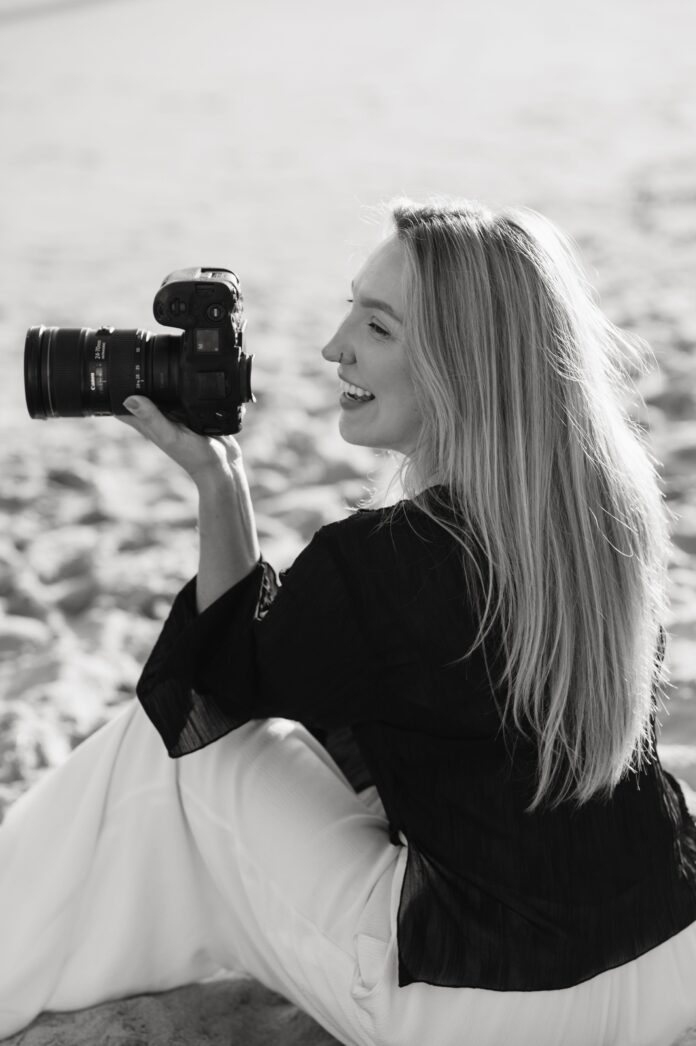
Author:
Tatyana Belova (Tanya Beloved)
Professional photographer, winner of the Best of Russia Award (2013, 2014), founder of a regional community of photographers in California.
Over the past 15 years, she has worked with more than 2,000 families in the U.S., Europe, and the CIS, published in Forbes, USA Today, and other international media.
Website: https://tanyabeloved.com
Keywords:
artificial intelligence, photography, authorship, visual ethics, emotional authenticity, uniqueness, creative industries, human–AI interaction
Abstract:
This paper investigates how the rise of generative AI technologies transforms the conceptual and emotional nature of photography. Drawing on the author’s practical experience and analysis of current AI tools, the article explores the erosion of authorship boundaries, the redefinition of uniqueness, and the risks and opportunities posed to emotional authenticity in visual storytelling. The research includes case observations, interviews with clients, and comparative analysis of AI-generated vs. human-created imagery. The author argues for a new ethical framework for photographers that prioritizes emotional presence and contextual intention in the creation of visual narratives.
Main Text:
1. Introduction: A Frame No Longer Human by Default
Until recently, the click of a shutter implied human presence — a moment of observation and intention. But with the development of tools like Midjourney, DALL·E, and Adobe Firefly, the process of “capturing” has been separated from reality. We now face the question: does a photo require a subject, or even a camera?
2. Hypothesis
In an era when AI can simulate faces, emotions, and lighting conditions, can human photography maintain its value as an emotional and authentic art form? And if so, what attributes make a frame irreplaceably “human”?
3. Methodology
- 15 comparative interviews with clients who viewed both AI-generated family portraits and real photographic sessions.
- 3 experimental series where clients reviewed two sets of images without knowing which were AI-made.
- Observation of post-shoot emotional impact over a 30-day period.
- Reflection on 2000+ family sessions over the last decade, noting typical emotional reactions and feedback patterns.
4. Findings
4.1. The Boundary of Authorship
AI-generated images blur the idea of authorship. Prompts replace presence; algorithms imitate intention. Yet clients consistently identified emotional disconnect in AI images — even when technically impressive.
“It’s beautiful… but I don’t feel like it’s us.”
— Comment from client reviewing AI-generated “family portrait”
The act of co-creation during a shoot — laughter, shared stories, spontaneous gestures — embeds human presence into each frame. Authorship here is not only about pressing the button; it is about witnessing.
4.2. Uniqueness Is Process, Not Pixels
In human photography, uniqueness arises from the moment — the light that fell across a child’s face, the shadow that flickered when someone turned away. In contrast, AI relies on patterns.
Photographic uniqueness is therefore not visual, but situational: it is tied to context, mood, and trust.
4.3. Emotional Authenticity as the True Frontier
Emotional authenticity cannot be synthetically inserted. Even the best deepfake cannot recreate the subtle vulnerability of someone trusting the photographer. Emotional depth arises through relational presence, not visual perfection.
5. Discussion
Photographers must adapt. Not by competing with AI in terms of speed or convenience, but by deepening what machines lack — connection, interpretation, and empathy.
The “future photographer” is not just an image-maker, but a meaning-curator.
6. Conclusion
AI will continue to shape the visual world — but it cannot replace human presence. The camera, when guided by empathy and trust, remains an instrument of authenticity. Photographers must not fear AI, but must reassert their value: not as button-pushers, but as emotional witnesses.
References:
- Manovich, L. (2022). AI Aesthetics. Strelka Press.
- Elkins, J. (2019). What Photography Is. Routledge.
- Hertzmann, A. (2020). “Can Computers Create Art?” Communications of the ACM, 63(5), 45–53.
- McCormack, J., Gifford, T., & Hutchings, P. (2019). “Autonomy, Authenticity and Intention in AI Art.” Journal of Creative Technologies.
- Rose, G. (2021). Visual Methodologies. SAGE Publications.
August 3, 2024

