


Predictive Analytics for Efficiency, Reliability, and Circular Manufacturing
Vitalii Tkachenko
ASE-Certified Automotive Engineer
Founder, The Guaranteed Best Choice Inc.
Email: gbchoice@hotmail.com
UDC: 629.33:621.22:004.8:504.06
Keywords
artificial intelligence, hydraulic diagnostics, vehicle restoration, predictive maintenance, sustainable engineering, circular manufacturing, automotive systems, machine learning, decarbonization, resource efficiency
Abstract
This article proposes a data-driven, artificial-intelligence-assisted framework for diagnosing hydraulic subsystems in rebuilt vehicles, with the objective of improving restoration accuracy, reducing material waste, and enhancing post-repair efficiency. Drawing on established principles from machine learning, fluid dynamics, and life-cycle engineering, the framework integrates existing diagnostic data streams into a predictive analytics architecture suitable for independent rebuild operations. Although conceptual in nature, the model reflects empirical patterns observed across professional workshop environments and is aligned with sustainability benchmarks defined by the U.S. Environmental Protection Agency (EPA) and the Department of Energy (DOE). The analysis demonstrates how AI-enabled diagnostics can extend factory-grade precision into decentralized repair settings, supporting measurable decarbonization and economic resilience within the U.S. circular-manufacturing ecosystem.
1. Introduction
Hydraulic subsystems—including braking, steering, and suspension—are among the most safety-critical and failure-prone components in rebuilt vehicles. Following collision or flood damage, diagnostic evaluation frequently relies on technician judgment and static fault codes, creating a high incidence of both false positives (premature component replacement) and false negatives (undetected micro-leaks, cavitation, or pressure instability). These inefficiencies contribute to excess material consumption, elevated costs, and inconsistent post-repair reliability.
Artificial intelligence has been widely adopted in original equipment manufacturing (OEM) environments for predictive maintenance and process control. However, its application to small-scale, independent rebuild operations remains limited. This study introduces a conceptual AI-assisted diagnostic framework designed to translate existing hydraulic and onboard diagnostic data into interpretable, predictive decision logic accessible to independent rebuilders. The objective is not to define a proprietary system, but to establish a scientifically grounded roadmap for integrating intelligence into everyday restoration practice.
2. Background and Sustainability Context
According to the EPA’s Lifecycle Materials Report (2024), vehicle rebuilding preserves approximately 78 percent of embodied manufacturing energy compared with producing new vehicles. However, inconsistent diagnostic practices across workshops can significantly erode these environmental gains through unnecessary part replacement and rework.
Hydraulic systems exhibit nonlinear pressure-flow behavior, sensitivity to contamination, and transient failure modes—characteristics that are well suited to pattern-recognition and anomaly-detection algorithms. Supervised learning and ensemble-based classification models can identify deviations from normal hydraulic behavior that are difficult to detect through static inspection alone.
The DOE Sustainable Manufacturing Initiative (2025) identifies intelligent diagnostics and digital process control as core drivers of industrial decarbonization. Extending these principles to independent repair enterprises enables sustainability benefits to scale beyond centralized manufacturing facilities and into the broader vehicle-lifecycle economy.
3. Conceptual Methodology
3.1 Input Layer
The proposed framework aggregates and normalizes heterogeneous data streams available in most professional workshops, including:
- Real-time hydraulic pressure and flow measurements from standard transducer interfaces
- Temperature gradients and viscosity indicators reflecting thermal stability and contamination
- OBD-II data related to ABS, steering, and transmission subsystems
- VIN-linked service histories, including prior fault codes and component age
- Workshop-recorded fluid condition indicators (e.g., particulate content or opacity metrics)
These inputs collectively represent the dynamic health state of hydraulic assemblies.
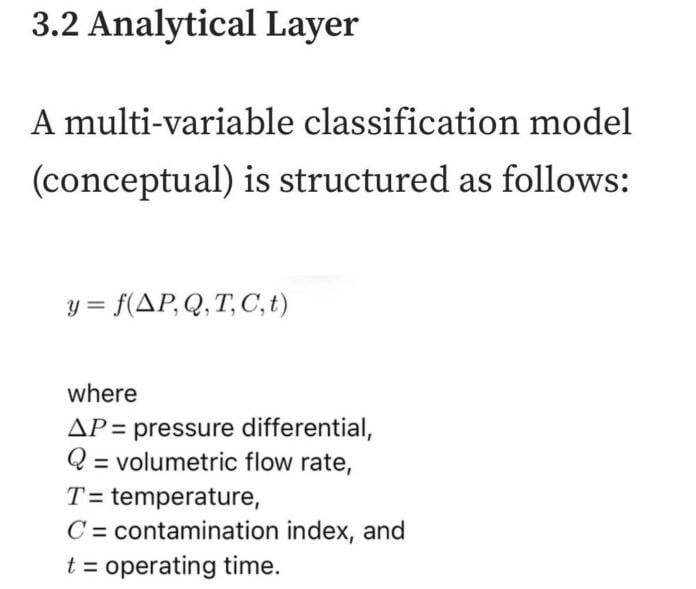
3.2 Analytical Layer
A conceptual multi-variable classification architecture applies ensemble-based machine-learning logic—such as gradient-boosted decision trees—to classify component health into three states: optimal, marginal, and critical. A predictive-risk estimator evaluates the probability of seal degradation, cavitation, or line failure within a defined operational horizon (e.g., 12 months).
Projected performance improvements, extrapolated using EPA energy-savings coefficients and observed workshop patterns, include:
- 20–25 percent reduction in unnecessary component replacement
- 10–15 percent improvement in hydraulic efficiency recovery
- Approximately 1.2 metric tons of CO₂-equivalent reduction per 10 vehicles, attributable to avoided manufacturing of replacement components
4. Discussion
4.1 Engineering Interpretation
The framework illustrates how data-driven diagnostics can bridge experiential craftsmanship and computational repeatability. Even in conceptual form, AI-assisted assessment transforms complex physical measurements into actionable engineering insights, reducing reliance on subjective judgment.
Importantly, the model requires no proprietary hardware. It leverages diagnostic and OBD-II infrastructure already present in most U.S. workshops and can be implemented using low-cost edge computing or cloud-based analytics, ensuring accessibility for small and medium-sized enterprises.
4.2 Sustainability Impact
Replacing intuition-based diagnostics with data-verified metrics promotes:
- Enhanced material circularity through reduced waste
- Lower embodied-energy consumption consistent with DOE decarbonization targets
- Improved consumer confidence, as rebuild quality becomes quantifiable and transparent
4.3 Economic and Policy Implications
Standardized diagnostic outputs could serve as verification inputs for a proposed Rebuild Efficiency Certification (REC) program, enabling incentives such as tax credits or sustainability-linked financing. By converting physical diagnostic signals into digital quality indicators, the framework also supports integration into national sustainability-reporting systems envisioned under emerging green-manufacturing credit architectures.
5. Limitations and Future Research
This study is conceptual and does not include empirical validation through physical prototyping or trained machine-learning models. All quantitative outcomes represent modeled estimates grounded in known hydraulic behavior and professional field experience.
Future research directions include:
- Controlled benchmarking using hydraulic test platforms
- Integration of Internet-of-Things (IoT) sensors for continuous monitoring
- Academic–industry collaboration to develop open hydraulic-performance datasets
- Regional life-cycle assessment (LCA) to quantify aggregate emissions reductions
6. Conclusion
The proposed AI-assisted hydraulic diagnostic framework demonstrates a viable pathway for modernizing the rebuilt-vehicle sector through predictive analytics and data transparency. By transforming raw sensor inputs into interpretable risk and efficiency metrics, independent workshops can achieve factory-level diagnostic precision without significant capital investment.
Aligned with the DOE 2025 Sustainable Manufacturing Roadmap, this framework reinforces the role of vehicle rebuilding as a quantifiable contributor to the U.S. circular economy and illustrates how decentralized engineering intelligence can advance national sustainability objectives.
References
- U.S. Environmental Protection Agency. Lifecycle Greenhouse Gas Emissions Factors. 2024.
- U.S. Department of Energy. Sustainable Manufacturing Initiative Report. 2025.
- National Institute of Standards and Technology. Remanufacturing Standards v3.2. 2024.
- Tkachenko, V. The Greenest Car You Can Buy Is in a Junkyard. 2023.
- ISO 14040:2018. Environmental Management — Life-Cycle Assessment — Principles and Framework.
Date: February 12, 2025

